
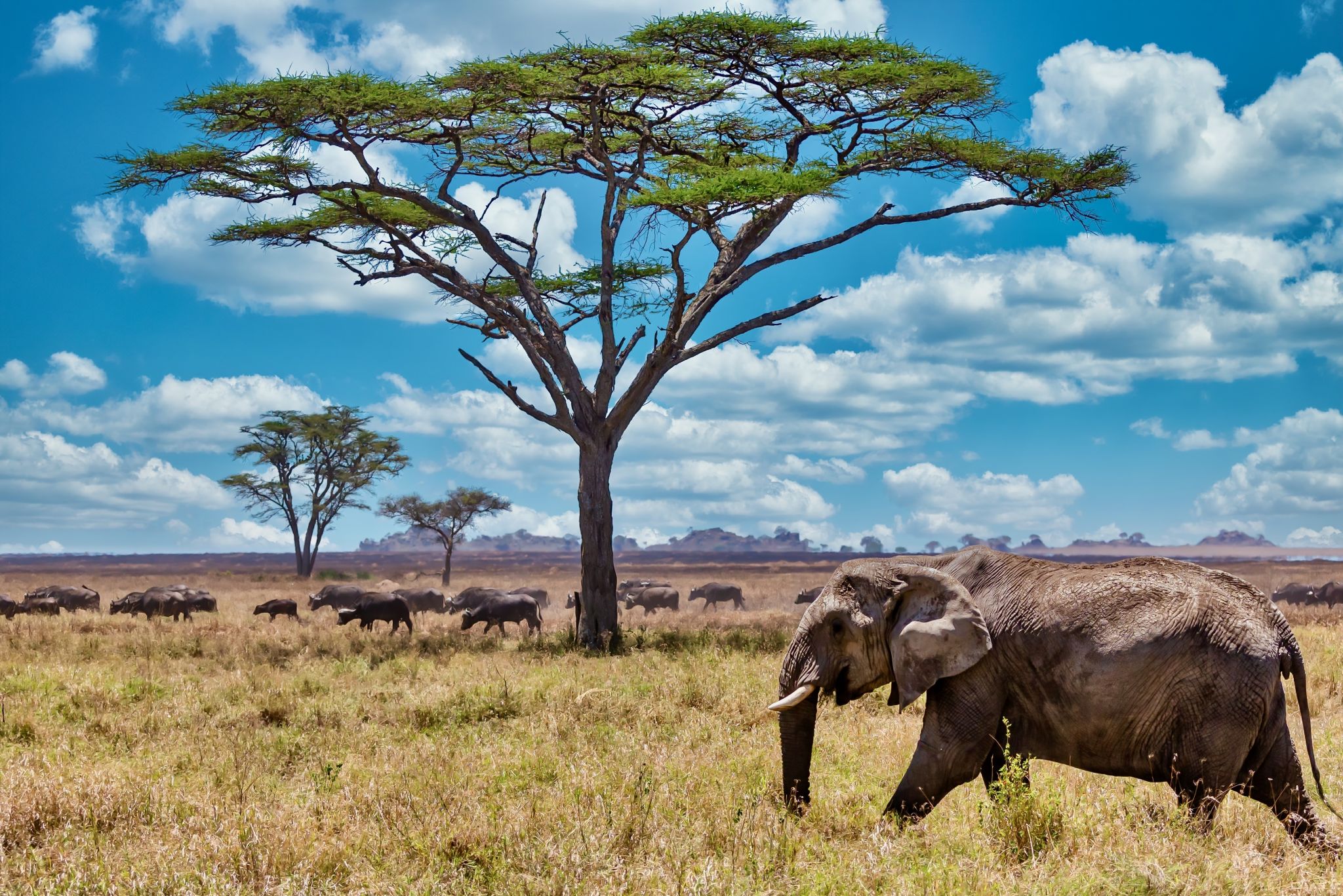
The Geographic Location of Serengeti in Tanzania
The Serengeti National Park stretches over 14,750 square kilometers (5,700 square miles) in northern Tanzania, bordering Kenya’s famed Maasai Mara. It’s nestled within the broader Serengeti ecosystem, which spans over 30,000 square kilometers. The park’s diverse terrain ranges from endless grass plains in the south to riverine forests in the west, and rugged hills and woodlands in the north.
This geographical diversity supports a wide array of wildlife species and offers breathtaking views that shift with the seasons. Its location makes it accessible from major cities like Arusha and Mwanza, and it’s a natural inclusion in the Northern Safari Circuit alongside Ngorongoro, Lake Manyara, and Mount Kilimanjaro.
Whether you fly into Serengeti via small charter planes or drive through scenic landscapes, the transition into this untouched wilderness feels like entering another world entirely an unfiltered Africa that time forgot.
History and Establishment of Serengeti National Park
Serengeti’s story is as rich as the land it protects. The name “Serengeti” derives from the Maasai word siringet, meaning “the place where the land runs on forever.” This poetic name perfectly captures the endless horizon of the Serengeti plains.
Established in 1951, Serengeti National Park was created to protect the ecosystem, especially the migration paths of wildebeest and zebras. At the time, unchecked hunting and human encroachment threatened wildlife. Conservation pioneers, including the renowned Bernhard Grzimek and his son Michael, brought global attention to the Serengeti with their documentary Serengeti Shall Not Die, which played a crucial role in preservation efforts.
Over time, the park evolved into a symbol of sustainable tourism and global conservation. Today, Serengeti National Park Tanzania travel represents not just an escape but a step into a legacy of environmental protection.
Why Serengeti is a UNESCO World Heritage Site
Serengeti earned UNESCO World Heritage status in 1981—and for good reason. Its natural value is unparalleled. The park is home to the world’s most significant terrestrial mammal migration, the Great Migration, and supports one of the highest densities of large predators, including lions, leopards, cheetahs, and hyenas.
Moreover, it maintains a delicate ecological balance, where over 500 bird species, 300 mammal species, and thousands of plant types coexist. Serengeti is a living laboratory of evolutionary biology, ecological processes, and predator-prey dynamics, making it vital for both scientific study and biodiversity preservation.
The World Heritage designation ensures that Serengeti receives global support for conservation and is recognized as one of Earth’s most vital ecosystems.
When is the Best Time to Visit Serengeti?
The beauty of Serengeti National Park Tanzania travel is that there’s no bad time to go—it just depends on what you want to see.
- January–March: Calving season in the southern Serengeti. Thousands of wildebeest give birth, and predators abound.
- April–May: The park is lush and green due to the rains, perfect for photographers but less ideal for game viewing.
- June–July: The Great Migration begins moving north. Excellent time to see river crossings in western Serengeti.
- August–September: Best for witnessing dramatic Mara River crossings in northern Serengeti.
- October–December: The herds begin returning south, with rich wildlife experiences in central Serengeti.
Shoulder seasons (April-May and November) offer budget-friendly travel options, while peak migration months require early bookings and carry premium prices. Regardless, wildlife is present year-round, making any visit rewarding.
The Great Wildebeest Migration: Nature’s Grand Parade
Perhaps the most iconic reason to embark on Serengeti National Park Tanzania travel is to witness the Great Migration. Every year, over 1.5 million wildebeest, 200,000 zebras, and 500,000 gazelles migrate in a clockwise loop from Serengeti to Maasai Mara and back, in search of fresh grazing lands and water.
This epic journey covers nearly 1,800 miles and is fraught with danger. Predators lurk in the shadows, rivers filled with crocodiles challenge crossings, and the sheer exhaustion tests each animal’s will to survive. The drama of life and death unfolds daily, offering travelers an unparalleled natural spectacle.
Two main highlights include:
- Grumeti River Crossing (June–July)
- Mara River Crossing (August–September)
These crossings are nature’s version of a blockbuster—complete with suspense, action, and emotion.
Top Wildlife to Spot in Serengeti National Park
Serengeti is teeming with wildlife, making every safari game drive a treasure hunt. From stealthy predators to graceful grazers, here are the top animals to spot:
- Lions: Over 3,000, the largest population in Africa
- Leopards: Often seen in central Serengeti’s Seronera Valley
- Cheetahs: Best spotted on the open plains
- Elephants & Buffaloes: Common across all regions
- Hyenas, Jackals, & Caracals: Abundant scavengers
- Zebras & Wildebeest: Migration stars
- Hippos & Crocodiles: Found in rivers and pools
- Rare Antelopes: Including the oribi, eland, and topi
Add to this a chorus of birds, insects, and reptiles, and Serengeti becomes a living, breathing ark of biodiversity.